Managing hundreds of Kubernetes clusters can make incident response a significant challenge for enterprise SRE teams. At Coderise, we built an AI SRE Agent that automatically investigates alerts, gathers logs, metrics, and traces, performs root cause analysis, and provides evidence-backed remediation suggestions.
When an alert fires, an SRE engineer shouldn’t have to spend the first 10–15 minutes navigating dashboards and manually collecting evidence before understanding what happened. The AI SRE Agent is designed to reduce that investigation time by bringing relevant operational context directly to the engineer.
The Problem: An Alert Is Only the Beginning
A monitoring system can tell you something is wrong. It rarely tells you why.
A typical incident workflow looked like this:
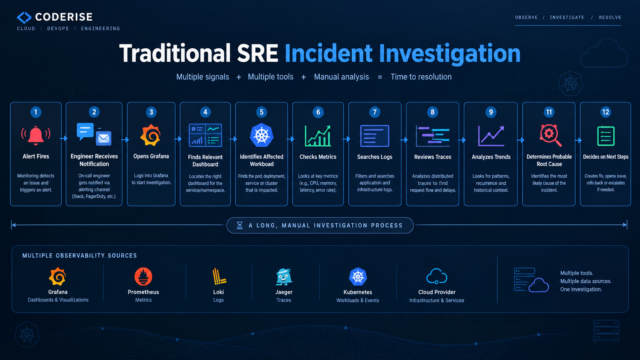
As infrastructure grows, the questions multiply. Which cluster is affected? Which environment? Which service generated the alert? What happened just before the incident? Are there matching log errors? Do metrics show resource saturation? Are traces pointing to downstream failures? Is this isolated or part of a larger trend? What changed recently?
The data already exists in the observability stack. The bottleneck is the time required to collect and connect it.
How Our AI SRE Agent Automates Incident Investigation
To solve this, we implemented an SRE Agent architecture that sits between the alerting system, observability data, and a centralized AI inference server. The goal was not to replace the SRE. The goal was to eliminate the repetitive investigation work that happens between receiving an alert and understanding the incident.
The architecture consists of:
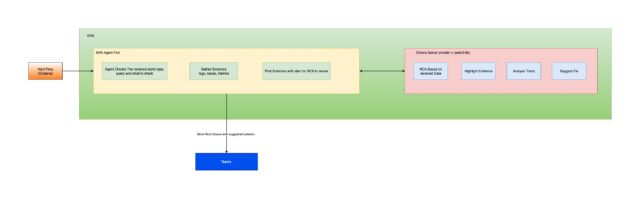
- Grafana for alerting
- SRE Agent pods that classify the alert and gather evidence
- Observability sources (logs, metrics, traces)
- A centralized Ollama server running the Qwen3:8B model on a GPU node
- Teams for delivering the final root cause, evidence, and suggested remediation
We deliberately separated the agent execution layer from the LLM inference layer. Separate SRE Agent instances run for different environments, clusters, and business domains, while all of them share the same Ollama-based LLM server. This design keeps agents close to their local telemetry while centralizing the computationally expensive model inference.
How the SRE Agent Works
When an alert is generated, the SRE Agent does not simply forward it to the LLM. It first determines the type of incident and what evidence should be collected.
The workflow is:
- Alert Classification
The agent evaluates the alert type. A CPU-related alert requires different evidence from a pod restart, latency spike, application error, or availability issue. This allows a more targeted investigation. - Automated Evidence Gathering
The agent collects relevant data, including application logs, Kubernetes events, metrics, distributed traces, resource utilization, error rates, latency trends, and recent anomalies. The SRE no longer needs to jump between multiple dashboards to gather the initial context. - AI-Powered Root Cause Analysis
The collected evidence is sent to the centralized LLM server. The model analyzes the data together and focuses on four areas:
- Root Cause: the most probable reason for the incident
- Evidence: the specific logs, metrics, traces, or events that support the conclusion
- Trend Analysis: what changed before or during the incident
- Suggested Fix: recommended actions for the SRE to validate and execute
The final output is delivered to the SRE team through Teams. Instead of a basic alert such as “CPU utilization exceeded threshold on cluster X,” the team receives a structured incident context containing the probable root cause, supporting evidence, observed trends, and suggested remediation.
This shifts the starting point for the engineer from “Something is wrong. Let me investigate” to “Here is what happened, here is the evidence, and here is what the agent recommends we look at next.”
Designing for Multiple Kubernetes Environments
A key requirement was scalability across many clusters and environments. We therefore separated the agent layer from the inference layer.
Each environment or business domain can have its own SRE Agent with access to the relevant telemetry and operational context. These agents communicate with the same centralized LLM inference server running on a GPU-enabled node. This provides a practical balance between isolation and efficient use of AI resources.
Why This Matters for Enterprise SRE
In a small environment, spending 10 to 15 minutes investigating an alert may not seem costly. At enterprise scale with hundreds of clusters and multiple alerts throughout the day, that time adds up quickly.
The AI SRE Agent moves the investigation step earlier in the workflow. Instead of spending the first several minutes collecting information, the engineer receives an initial analysis that already includes the probable root cause, supporting evidence, relevant telemetry, observed trends, and suggested remediation.
This allows the SRE team to spend more time on validation, decision-making, and remediation rather than repetitive data gathering.
The Business Impact
The value of this implementation is not simply that an LLM was added to the monitoring stack. The real value comes from reducing the time between detection and understanding.
For enterprise clients this translates into:
- Faster incident response because relevant context arrives with the alert
- Reduced mean time to recovery by accelerating investigation and root-cause identification
- Lower operational load as the agent handles repetitive evidence collection
- Better use of SRE expertise so engineers focus on resolving problems rather than collecting telemetry
- Improved system availability through shorter incident duration
AI as an SRE Force Multiplier
The most important lesson is that AI does not need to replace existing SRE practices to create value. The observability stack already produces large amounts of useful information. The challenge is turning that information into actionable context quickly enough.
Our approach places an intelligent investigation layer on top of the existing monitoring and observability infrastructure.
Traditional SRE workflow:
Alert → Human Investigation → Evidence Collection → RCA → Fix
AI-assisted SRE workflow:
Alert → AI Investigation → Evidence + RCA + Recommendation → SRE Validation → Fix
The SRE remains responsible for the final decision. The AI simply reduces the time required to reach that decision.
What’s Next
This implementation provides the foundation for moving from AI-assisted investigation toward controlled remediation. With appropriate guardrails, permissions, and approval workflows, the same architecture can support automated remediation for well-understood and low-risk incident scenarios.
Conclusion
Managing infrastructure across hundreds of Kubernetes clusters requires more than good monitoring. It requires the ability to turn monitoring signals into actionable information quickly.
At Coderise, we combined Kubernetes, observability, AI agents, and centralized LLM inference to create an AI-powered SRE workflow for enterprise environments. An alert now triggers an automated investigation that gathers logs, metrics, traces, and trends, analyzes the evidence, and delivers a probable root cause with supporting evidence and suggested fixes to the SRE team.
The objective is not to remove humans from incident management. It is to give SRE engineers the right context faster so they can spend less time searching for the problem and more time solving it.
When you operate at enterprise scale, saving those first 10 to 15 minutes of every investigation makes a meaningful difference to incident response, recovery time, operational efficiency, and system availability.